
Mountain Gorillas are one of the rarest large mammal species in the world.
Their small and fragile populations are found in a truly remarkable region of Africa, the western rim of the Great Rift Valley, where the drainage basin of the Nile River is separated from the Congo River and the two largest rivers of the continent, with the second and third largest rivers in the world.
This highland region is characterised by both dormant and active volcanoes, some of which are capped with snow, the aptly named ‘’Impenetrable Forest’’ in Uganda and the misty Hagenia forests draped with dangling moss and twisted vines and orchids of the Virunga’s.
This ancient forest in Uganda’s mountainous south-western corner boasts an impressive biodiversity with 350 birds, 310 butterflies, 200 trees, 51 reptiles, 88 moths and 120 mammals, including the rare and unforgettable mountain gorillas.
Mountain gorillas are protected in four national parks in three countries. The national park authorities of Rwanda, Uganda and Democratic Republic of Congo, co-ordinate their activities and monitor wildlife and illegal human activities throughout the gorillas’ habitat.
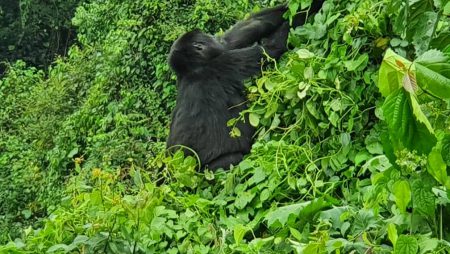
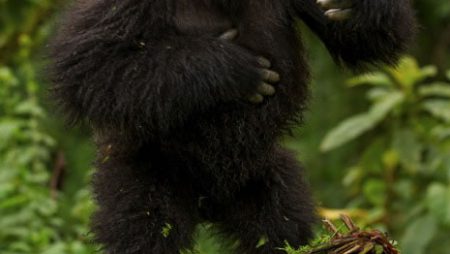
These forests are home to the mountain gorilla families, led by the dominant alpha silver back males weighing up to 250kg and protecting their harem families of females much smaller than the males and young gorillas.
Trekking mountain gorillas in Bwindi Forest is a peerless wildlife experience, and one of Africa’s indisputable travel highlights. It is difficult to describe the simple exhilaration attached to first setting eyes on a wild mountain gorilla.
Despite their fearsome size and appearance, gorillas are remarkably peaceable creatures, certainly by comparison with most primates; gorilla tracking would be a considerably more dangerous pursuit if these giants had the temperament of Vervet monkeys, say or baboons or for that matter, humans.
Gorillas build their nests for sleeping at night. They use leaves and other plant material to make these one night resting spots.
Researchers can estimate the size and age structure of a group by how many nests are constructed and the size of the fences by the nest. As infants share with their mothers, these nests will have large and small fences next to them.
Equally fascinating is the extent to the gorillas try to interact with their visitors, often approaching them, and occasionally touching one of the guides in apparent recognition and greeting as they walk past.
A photographic tripod raised considerable curiosity in several of the youngsters and a couple of the adults- one large female walked up to the tripod, stared ponderously into the lens, then wandered back off evidently satisfied. It almost as if these gorillas recognize their daily visitors as a troop of fellow apes.
It should be noted that close contact with humans can expose gorillas to fatal diseases, for which reason the guides try to keep their tourists at least 7m away but the guides try to keep their tourists at gorillas from flouting rules of which they are unaware.
The magical hour with the gorillas is relatively expensive and getting there can sometime be hard work.
The hike up to the mountain gorillas’ preferred habitat of bamboo forest involves a combination of steep slopes, dense vegetation, slippery underfoot conditions after rain and high altitude. For all that, the more accessible gorilla groups can be visited by reasonable fit adults of any age.
About the gorilla trekking permits, it is eight gorilla safari permits per day are issued for each of the eight habituated groups of people in Bwindi Impenetrable Forest National Park, making a daily total of 80 permits.
At the time of writing all these habituated groups stay within tracking range on a more or less permanent basis, but gorillas are not governed by international boundaries and it is always possible that groups which originated in Rwanda or D.R.C Congo might cross there again.
Trackers are allocated gorilla families through tracking sectors which include; Buhoma, Ruhija, Nkuringo and Rushaga sector, all these sectors have gorilla families allocated to visitors to track and generally make an effort to match people to a group based on their apparent fitness.
The strictly enforced minimum age for tracking gorillas is 15 years and above, the gorilla permits including park entrance costs $600 USD.
The permit is best brought in advance through the UWA office in Kampala or through a tour operator of any trusted company. There is no guarantee a permit will be available on any given day, booking 6-12 months ahead is strongly advised.
In any event, the procedure regarding last minute bookings could always change, so you are strongly advised to check this beforehand UWA.
Trackers are required to check in at UWA park headquarters at 7:30am where they can be briefed in time and if necessary make use of the last clean toilets they will see for a few hours before being allocated to one of the 5 habituated groups. After the briefing about the gorillas and forest, gorillas groups are porter, they are hired at only 15 USD per person.
On your way to gorilla trekking
The trek to see the gorillas has two phases; the first is the hike from the closest car park to the forest and national park boundary which usually takes 30 to 60 minutes’ walk depending in the speed of the members and the group they are visiting.
The second trek is when you enter into the forest in search of the gorillas which will usually have been located by the knowledgeable trackers by the time tourists reach the forest edge.
This may take anything from 2 hours especially for those groups whose territory lies closer to the forest edge, but others can take from 2 to 8 hours depending on the location and movements of the group which involves longer and steeper ascent.
The first part of the trek is predictable and it is usually quite flat and undemanding, but the second part is more difficult to predict as it will depend on the exact location of the gorillas on that day and on the steepness of the terrain en-route.
Other factors in demanding how tough it can be include the weather conditions and altitude in most cases when it is muddy and slippery underfoot.
Guides will generally offer you a walking stick at the start of the hike to help support you on those slippery mountain paths. If you have luggage, you can then hire a porter too.
Once on the trail, take it easy and do not be afraid to ask or stop for quick calories like snacks and water.
Once with the gorillas, try to keep a distance of 7 meter rule, tourists are permitted to spend no longer than one hour with the gorillas and it is forbidden to eat, urinate or defecate in their presence.
You can capture many photos and videos as you want but without using a flash. You are given only 1 hour to be with the mountain gorillas, and once the 1 hour is finished, you then hike back to the starting point and receive your gorilla trekking certificates.
What to wear and take on your gorilla trekking experience
Park your sturdiest hiking boots, thick trousers, gaiters and long-sleeved top as protection against vicious stinging nettles. It’s often cold when you set out, so start off with a sweatshirt or jersey which also helps to protect against nettles.
The gorillas are thoroughly used to people, so it makes little difference whether you wear bright or muted colours, whatever clothes you wear are likely to get very dirty as you slip and slither in the mud, so if you have pre-muddied clothes you might as well wear them.
When you are grabbing for handholds in thorny vegetation, a pair of old gardening gloves are helpful. During the rainy season, a poncho or raincoat might be a worthy addition to your day pack, while sunscreen, sunglasses and a hat are a good idea at any time of year.
You may well feel like a snack during the long hike and should certainly carry enough drinking water at least one litre. You must not forget to carry a camera gear for you camera, Binoculars are not necessary to see the gorillas.
In theory, birdwatchers might want to carry binoculars, though in practice the most dedicated are likely to make use of them.
The trek up to the gorillas is normally very directed and walking up the slopes and through the thick vegetation tends to occupy one’s eyes and mind.
If you are carrying much gear and food /water, it’s advisable to hire one of the porters who hand about at the car park in the hope of work. This costs from 10 to 15 USD per porter. You will need to show you passport when you check in, so do not forget to bring it along.
No Comment
You can post first response comment.