
Welcome to Visit Gorilla Travel Guide – It is on this guide that you will find all the gorilla conservation information, tours, lodges in Uganda, Rwanda & DRC Congo.
Visit Gorilla Travel Guide aims at providing information on gorilla conservation programs in the African countries where mountain and low land gorillas are found.
You can join our work of conserving the gorillas and other primates!
The private guided gorilla Eco tours are designed by some of the Eco tours companies some of the safari fund percentage goes to the support of our conservation programs, and some packages are customized at taking the visitors to experience the conservation work at the Gorilla Doctors facilities.
Every year some leading companies with their photography tour leader, conduct trips in Uganda, Rwanda & DRC Congo and clients gets a day to visit the gorilla conservation organizations!
If you are on a tight travel plan and you want see the gorillas, on this travel guide you can find the best gorilla tour company that offers the best affordable short day gorilla trek in Rwanda, Uganda & DRC Congo and other major tourism highlights.
Travel with one of the trusted listed travel agency and you will explore the gorillas and other primates attractions and discover the remaining great apes in nature.
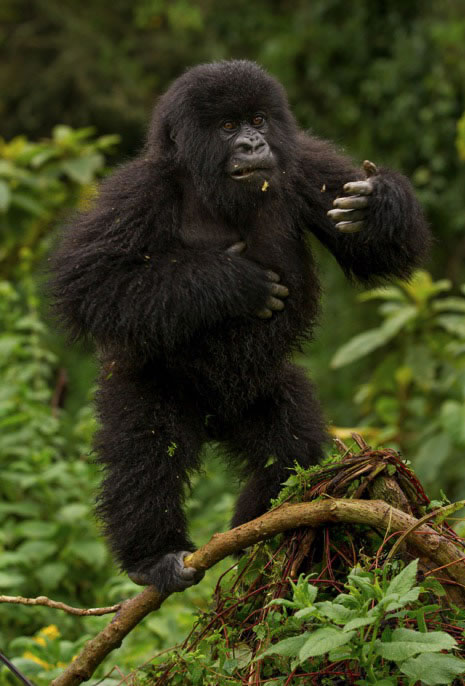
About Gorillas are ground-dwelling, predominantly herbivorous apes that inhabit the forests of central Africa. The eponymous genus Gorilla is divided into two species: the eastern gorillas and the western gorillas, and either four or five subspecies.
They are the largest living primates by physical size. The DNA of gorillas is highly similar to that of humans, from 95–99% depending on what is counted, and they are the next closest living relatives to humans after the chimpanzees and bonobos.
Gorillas’ natural habitats cover tropical or subtropical forests in Africa. Although their range covers a small percentage of Africa, gorillas cover a wide range of elevations.
The mountain gorilla inhabits the Albertine Rift montane cloud forests of the Virunga Volcanoes, ranging in altitude from 2,200–4,300 metres (7,200–14,100 ft).
Lowland gorillas live in dense forests and lowland swamps and marshes as low as sea level, with western lowland gorillas living in Central West African countries and eastern lowland gorillas living in the Democratic Republic of the Congo near its border with Rwanda.
The closest relatives of gorillas are chimpanzees and humans, all of the Homininae having diverged from a common ancestor about 7 million years ago.
Human gene sequences differ only 1.6% on average from the sequences of corresponding gorilla genes, but there is further difference in how many copies each gene has.
Until recently, gorillas were considered to be a single species, with three subspecies: the western lowland gorilla, the eastern lowland gorilla and the mountain gorilla. There is now agreement that there are two species with two subspecies each.
More recently, a third subspecies has been claimed to exist in one of the species. The separate species and subspecies developed from a single type of gorilla during the Ice Age, when their forest habitats shrank and became isolated from each other.
Primatologists continue to explore the relationships between various gorilla populations.
Gorilla tourism in Africa has done much as far as conserving the mountain and Lowland gorillas in Uganda, Rwanda & DRC Congo (Virunga & Kauzi Biega National Parks).
Most of the experiences that clients encounter with the gorillas are gorilla trekking and gorilla habituation and this is (Gorilla Habituation) specifically done in Uganda-Bwindi Impenetrable Forest National Park at the Rushaga sector of the Bwindi forest and it is 2 gorilla families (Bushaho & Bikingi) promoting the gorilla habituation experience!