
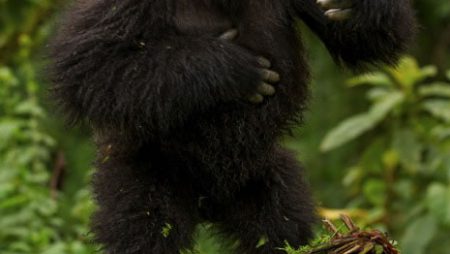
Virunga National Park in the Congo DRC is Africa’s oldest national park and home to a quarter of the world’s mountain gorillas and here you can experience the gorilla trekking tours in Congo.
Virunga’s Cessna 182 (photo:©Virunga National Park)
The Virunga National Park (French: Parc National des Virunga), formerly named Albert National Park, is a 7,800-square-kilometre (3,000 sq mi) National Park that stretches from the Virunga Mountains in the South, to the Rwenzori Mountains in the North, in the eastern Democratic Republic of the Congo, bordering Volcanoes National Park in Rwanda and Rwenzori Mountains National Park and Queen Elizabeth National Park in Uganda.
The park was established in 1925 as Africa’s first national park and is a UNESCO-designated World Heritage Site since 1979. In recent years poaching and the Congo Civil War have seriously damaged its wildlife population. The park is managed by the Congolese National Park Authorities, the Institut Congolais pour la Conservation de la Nature (ICCN) and its partner the Virunga Foundation, formerly known as the Africa Conservation Fund (UK).
It’s difficult to believe, but when Emmanuel de Merode took over stewardship of the park in July 2008, Virunga had no functioning aircraft. Getting across the park required days of dangerous overland travel and the ability to respond quickly to emergencies was virtually non-existent. Thanks to a grant from U.S. Fish and Wildlife Service and generous donations from private donors, Virunga got its first aircraft in late 2010 and it made a world of difference. What’s difficult to fathom is how the park managed without a plane for those interim years.
Virunga’s reliance on aircraft has continued to grow. With 7,800 square kilometers to manage, rangers need an omnipresent “big brother” in the sky. Belgian pilot, Anthony Caere, has taken on that role and is now leading Virunga’s Air Wing. On most days at park HQ in Rumagabo, Anthony can be heard taking off early in the morning and he’s often out until the end of the day. His returns are often marked by someone on staff casting a squinted look into the distance and saying, “Is that Anthony I hear?”. And as soon as he’s got his feet back on the ground, people gather around him to hear news about the park.

Anthony Caere, Head of Virunga’s Air Wing, and his passenger, Lulingu, a rescued baby lowland gorilla (photo:©Anthony Caere)
Anthony’s days flying throughout Virunga fall under seven major categories:
1. Park logistics: transporting mechanics to stricken vehicles or repair of radio systems
2. Site inspections: land incursions and poaching incidents
3. Operations – support of anti-poaching patrols
4. Surveillance and monitoring – elephant tracking and wildlife censuses
5. Medical – evacuations and delivery of medical supplies
6. Ranger training – moving trainers throughout the park
7. Maintenance – flights to Uganda for plane parts
If you’re wondering about #7, don’t worry, Anthony’s not flying a plane that needs parts in order to get parts. Virunga now has three other planes because each of the functions described above are suited to a particular type of aircraft — and because the park cannot afford to be without a plane. Redundancy is crucial, especially in the instance of having to evacuate a critically injured ranger.
Here’s a look at Virunga’s Air Wing:
1. Cessna 182: a four-seat aircraft with a “high-wing” configuration. Having the wings above the cockpit means nothing blocks one’s line of sight to the ground below. This plane is primarily used for aerial photography, mapping, and wildlife counts.
2. Cessna 206: a six-seat, high-wing plane capable of carrying more cargo than the C-182. This plane is used mostly for delivering equipment and supplies to ranger posts and for transport of wildlife, such a baby gorillas intercepted from animal traffickers. Because of its larger engine and size, the C-206 is less fuel-efficient than the C-182.
3. Zlin Savage Cub: a two-seat, high-wing, fuel-efficient, ultra-light aircraft that is used primarily for elephant monitoring. This plane was made possible by the Wildcat Foundation.
4. Zenair 701 STOL – a two-seat, high-wing, fuel-efficient, ultra-light aircraft that can take off and land on runways as short as 27 meters (89 feet.) This aircraft is used for monitoring and surveillance and is due to get 26” “bush” wheels so it can land on very rough surfaces.

Virunga’s Cessna 206 and members of the Congohounds team (photo:©Virunga National Park)
Virunga’s Air Wing is one of the many critical programs supported by public and private donations. We need your support to continue protecting Virunga!
No Comment
You can post first response comment.