
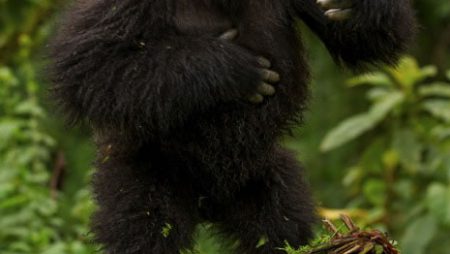
After decades of extreme survival pressure, the conservation status of Grauer’s gorillas, found only in the Democratic Republic of Congo, has just been officially raised to the highest threat level – critically endangered – by the International Union for Conservation of Nature.
The Dian Fossey Gorilla Fund collaborated with an international team to recommend this reassessment,” says Dr. Tara Stoinski, president and CEO/Chief scientific officer. “This change in status confirms what we already know from our work on the ground in the core of Grauer’s gorilla range – their situation is dire and if the current rate of decline continues, they could be extinct in as few as five years,” she reports.
The Fossey Fund is the only NGO with a permanent field station in the low-altitude core range of the Grauer’s gorilla, and now has four teams of trackers protecting them on a daily basis, with a fifth team in development. Other than separate populations protected by the Congolese wildlife authorities (ICCN) in two national parks, the Fossey Fund provides the only direct protection for this now critically endangered species.
“Most of the remaining Grauer’s gorillas live outside of protected areas,” says Dr. Damien Caillaud, the Fossey Fund’s research director for Congo programs and one of the authors on the Grauer’s current assessment. “And they are extremely sensitive to areas where poaching occurs. They won’t be found within a 5-8 kilometer range around mining camps, for example, so each such camp leads to gorillas leaving an area of some 30-50 square kilometers of forest. And there are many, many mining camps in the eastern Congo forest.”
A key feature of the Fossey Fund’s work in protecting Grauer’s gorillas in Congo is the involvement of local communities, especially traditional landowners. Field staff are hired from local villages, food supplies are bought from local crops, and community development efforts are underway, such as small-scale sustainable farm projects to help decrease malnutrition and bush meat hunting, and support for youth education.
“The Fossey Fund hopes that this multi-faceted model will build the basis for conservation action that can be applied throughout the range of Grauer’s gorillas, encouraging local groups to protect forests directly,” says Urbain Ngobobo, head of the Fossey Fund’s Congo programs.
The Dian Fossey Gorilla Fund works with other nonprofit organizations collaborating in the Conservation Action Plan (CAP) for protection of biodiversity in DR Congo. CAP is coordinated by the Jane Goodall Institute, with support from the Arcus Foundation. The Fossey Fund also works in conjunction with Congolese wildlife authorities (ICCN/Institut Congolais pour la Conservation de la Nature) and other international partners.
The Fossey Fund’s work with Grauer’s gorillas is supported by the Turner Foundation, U.S. Fish & Wildlife Service, and other donors.
Observing Grauer’s gorillas in Congo
Opportunities to closely observe endangered Grauer’s gorillas (found only in the Democratic Republic of Congo) are limited, because there is only one group that is fully habituated to the presence of humans (and one additional group in the process of being habituated). These two groups are located in Congo’s Kahuzi-Biega National Park, which is protected by Congolese wildlife authorities (ICCN).
Fossey Fund scientist Amy Porter, Ph.D., recently began collecting data on these groups, studying their behaviors, personalities and activities by observing them every day, as we do with the mountain gorilla groups in Rwanda. Some days, not all the gorillas of the group are seen, having spread out some distance or being hidden in thick vegetation. But when several days pass without seeing any particular member of the group, extra effort is put into locating them.
This happened recently when five group members were not seen for about a week, including one that Dr. Porter had been observing closely – a black back named Nabanga. Despite hours of targeted searching, two more weeks passed without finding them, until one day, there was Nabanga, and three of the others, feeding on leaves and fruit near the group again. A few of them had wounds or scars, suggesting they had run into some “adventures” with unhabituated gorillas somewhere, and the female did not return at all, probably having transferred to another group.
“We wonder whether Nabanga and the others will stay with the group or if some or all of them will go off on another adventure. Selfishly, I hope Nabanga sticks around, because his beautiful, calm presence is so very special.”
No Comment
You can post first response comment.